THE DETAIL TO KEEP
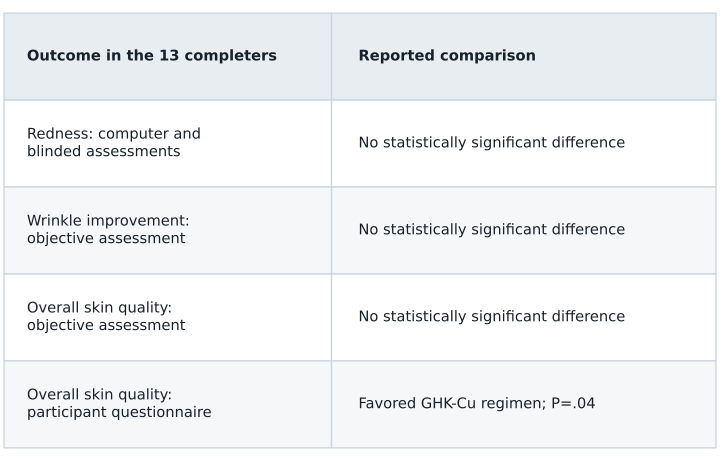
Thirteen patients completed the randomized post-resurfacing study; total enrollment and individual arm sizes are unreported in the abstract.
Sections in this fieldnote
Copper-peptide research spans laboratory cells, chronic wounds, and skin recovering from a procedure. Those settings share an interest in tissue repair, but they test different propositions. A cell producing more collagen is not the same outcome as a person seeing fewer wrinkles, and a favorable questionnaire result is not interchangeable with an instrument detecting less redness.
The useful question is therefore not whether GHK-Cu has one universal verdict. It is which comparison was performed, what each measurement captured, and how far the result travels. This analysis uses indexed primary report abstracts for the laser and cell studies, plus an author-posted full-text OCR of the ulcer trial. It does not presume access to every protocol, supplement, or formatted table.
Study facts at a glance
Laser-study population: Thirteen patients completed the randomized post-resurfacing study; total enrollment and individual arm sizes are unreported in the abstract. Source 1
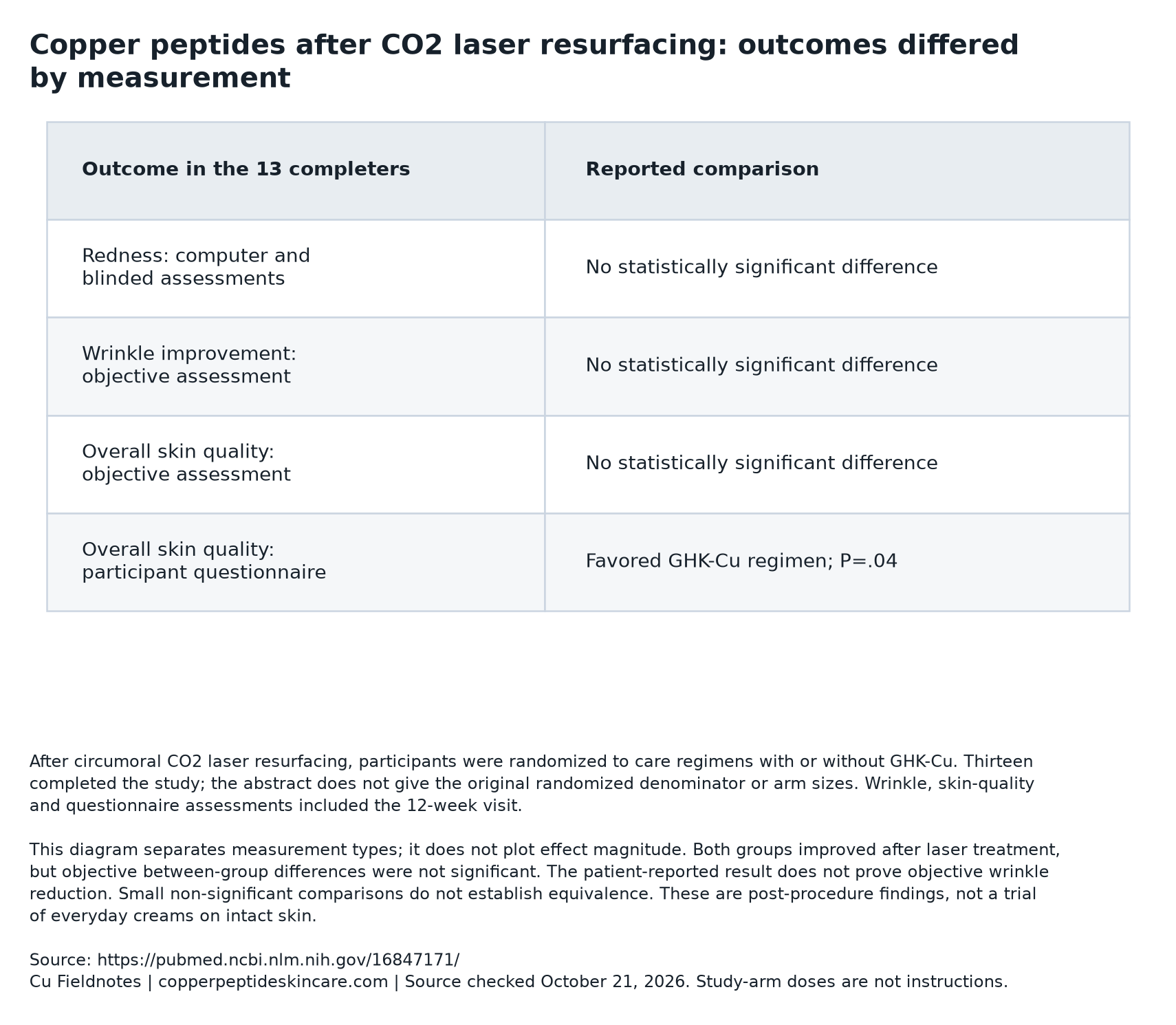
Objective comparisons: The laser abstract reports no statistically significant between-group benefit for redness resolution, wrinkles, or overall skin quality. Source 1
Patient-reported result: The questionnaire favored the GHK-Cu regimen, with P = .04; its effect size and confidence interval are unreported. Source 1
Different human setting: The diabetic-ulcer trial enrolled 181 people overall, not 181 people in the immediate-treatment plantar-ulcer comparison. Source 5
Mechanistic evidence: Fibroblast experiments examined collagen synthesis and matrix-remodeling signals, not visible facial outcomes or product delivery through skin. Source 3 Source 4
The laser experiment tested an added regimen after a procedure
Patients underwent carbon dioxide laser resurfacing around the mouth, then received topical regimens with or without GHK-Cu. Computer analysis and blinded evaluators assessed redness; wrinkle and appearance assessments and a validated questionnaire included a 12-week evaluation. The abstract does not identify a formally designated primary endpoint, product concentration, adverse-event counts, or funding.
That design asks about an incremental contribution: whether adding the copper-peptide regimen improves recovery or appearance beyond the comparison regimen after the same procedure. It does not ask whether laser resurfacing works, nor whether a retail cream improves untreated facial skin. Keeping the background procedure fixed is essential to interpreting the contrast.
Random assignment supports a causal comparison in principle, but it does not fill gaps in reporting. Knowing only the completer count leaves the initial allocation and follow-up flow unclear. The broader human-evidence guide provides a useful framework for separating the treatment setting from the ingredient name.
Read the underlying chart data: download CSV or download the source-labeled chart.
Improvement over time is not the added-treatment effect
Both laser-study groups improved in wrinkles and skin quality. That within-group change and the nonsignificant between-group comparisons answer different questions. Improvement after a procedure does not establish that every accompanying product contributed to it.
Consider an explicitly illustrative example, not study data: one group improves by four points on an appearance scale and another by five. Each group might show convincing improvement from its own starting point, while the one-point difference remains uncertain. The added-treatment question concerns that difference, not the size of either group's before-and-after change.
This distinction also prevents the opposite mistake. A nonsignificant comparison does not mean measurements stayed unchanged over time. It means the reported analysis did not establish a difference between the regimens. Reading the two contrasts separately preserves both the observed recovery and the uncertainty about an additional contribution.
Different measurements answer different questions; none substitutes automatically for another.
| Measurement | Question it addresses | Inference boundary |
|---|---|---|
| Laser-study redness assessment | Did redness resolve differently between regimens? | Does not measure collagen synthesis directly. |
| Laser-study questionnaire | Did patients report a different experience or appearance? | Does not establish a blinded wrinkle benefit. |
| Ulcer-area tracing | How much did the wound surface shrink? | Does not measure cosmetic improvement. |
| Fibroblast collagen synthesis | Did cultured cells alter collagen production? | Does not establish delivery or visible benefit in people. |
Patient ratings are meaningful without becoming objective proof
The questionnaire signal deserves to remain a finding, rather than being discarded because the blinded assessments did not show a significant advantage. A person's evaluation of skin quality is a legitimate outcome. Its meaning depends on the question asked and how the response was scored.
Interpretation: disagreement between measurement types need not be a contradiction. A questionnaire and an image analysis can sample different aspects of the experience. However, this report does not establish why they differed. It would be speculative to attribute the result to comfort, expectations, texture, or a particular biological pathway.
A P-value also leaves practical importance unresolved. To judge whether an advantage would matter to patients, readers need the questionnaire scale, the group difference, and an uncertainty interval. Statistical evidence against a no-difference model is not itself a measure of how noticeable, durable, or valuable an improvement was.
A small null comparison does not demonstrate equivalence
The absence of a statistically significant objective advantage is not proof that the regimens are equivalent. Equivalence requires a different inferential structure: investigators must specify how large a difference would matter and show that the uncertainty lies within acceptable bounds. An ordinary superiority test does not accomplish that by failing to reject its null hypothesis.
For illustration, two hypothetical studies can both report a nonsignificant result while conveying very different information. One might rule out all but tiny differences; another might remain compatible with substantial benefit or harm. Confidence intervals distinguish those situations. Without them, the laser abstract cannot show how narrowly the objective effect was estimated.
Multiple outcome domains create another interpretive question: which comparison was prioritized before results were known? The available report does not resolve the testing hierarchy. This does not erase the positive questionnaire result, but it supports treating it as a signal needing estimation and replication rather than a stand-alone verdict.
A useful reading exercise is to write down the decision an estimate is supposed to inform before looking at its P-value. If the question is whether people notice a worthwhile improvement, the relevant threshold must be expressed on a scale that describes that experience. If the question is whether redness resolves faster, the estimate needs an interpretable time or measurement unit. A single significance label cannot answer both questions, and a threshold chosen after seeing the results offers less protection against selective interpretation.
Collagen-producing cells provide a hypothesis, not a facial result
One fibroblast-culture study reported increased collagen synthesis without an accompanying change in cell number. The response began between 10^-12 and 10^-11 molar and peaked at 10^-9 molar. These are concentrations in an experimental culture system, not directions for formulating or applying a skincare product.
The experiment helps separate production per culture from the simple possibility of having more cells. Yet a chain of additional questions stands between this result and a cosmetic claim: does a formulation retain the relevant complex, does it reach the relevant tissue, and does the resulting response change a meaningful human endpoint?
Interpretation: a laboratory concentration is an exposure at the experimental site, whereas a bottle percentage describes material before application and delivery. Converting one into the other would require information not supplied by this experiment. The percentage and labeling guide explains why a larger label number cannot serve as a shortcut through that evidence chain.
Remodeling involves breakdown signals as well as production
A separate dermal-fibroblast experiment found increased MMP-2 protein in culture medium and increased MMP-2 messenger RNA. Copper ions reproduced the effect; the peptide alone did not. GHK-Cu also increased secretion of TIMP-1 and TIMP-2, inhibitors of matrix metalloproteinases.
Matrix metalloproteinases are enzymes involved in processing the extracellular matrix, the material surrounding cells. Their inhibitors help regulate that activity. Messenger RNA is an intermediate in gene expression; observing more of it is not the same as measuring a clinical tissue outcome. These distinctions matter because remodeling is not simply a one-way accumulation of collagen.
Interpretation: measuring both an enzyme-related signal and its inhibitors makes a simple more-is-better story inadequate. The net tissue effect depends on their interaction, location, and timing. The experiment supports further investigation of remodeling, but it does not establish the balance achieved in treated human skin or explain the laser questionnaire finding.
The ulcer trial adds human evidence under different conditions
The multicenter, randomized, evaluator-blinded ulcer study compared topical GHK-Cu gel with vehicle alongside standardized debridement, pressure-relieving footwear, and wound care. Immediate 2% treatment lasted up to eight weeks, followed by six weeks of observation. Delayed groups had four weeks of vehicle before eight weeks of vehicle, 2%, or 4% gel. These identify historical study arms, not treatment instructions.
The full-text narrative reports median wound-area closure of 98.5% versus 60.8% in the immediate-treatment plantar comparison. The endpoint used each person's last visit, not necessarily a common week-14 measurement. Delayed treatment did not show significant improvement over vehicle. ProCyte affiliations and development-team involvement establish commercial participation, without establishing a particular funding arrangement.
The companion diabetic-ulcer study analysis examines that clinical context more closely. For synthesis, the important point is that wound condition, background care, formulation, and timing all belong to the tested intervention. Removing them changes the question rather than merely simplifying the description.
Why evidence across these settings is complementary rather than interchangeable.
| Research setting | Comparison or exposure | What remains to be demonstrated elsewhere |
|---|---|---|
| Post-laser circumoral skin | Topical regimens with versus without GHK-Cu | Effects on untreated skin and other formulations |
| Diabetic neuropathic ulcers | Study gel versus vehicle with clinical wound care | Cosmetic outcomes and routine facial use |
| Collagen cell experiment | GHK-Cu exposure in fibroblast culture | Delivery and meaningful human appearance changes |
| Remodeling cell experiment | Matrix-enzyme and inhibitor responses in culture | Net clinical tissue effects and tolerability |
Source 5 Source 1 Source 3 Source 4
Wound-area percentages require their own arithmetic
The ulcer medians describe changes in area, not the percentage of people whose ulcers healed. Subtracting the reported medians gives 37.7 percentage points of separation in that area-based measure. It does not produce an individual treatment benefit, a healing probability, or a number needed to treat.
For an illustrative calculation, a wound shrinking from 200 to 20 square millimeters has 90% area closure. It remains open. A group median near complete area reduction therefore need not mean that nearly everyone achieved complete healing. A categorical endpoint counting people above a closure threshold would answer a separate question.
Endpoint timing adds another layer. A last-visit analysis can include people observed for different lengths of time, while the separate time-course analysis carried the last measurement forward, treating later unobserved measurements as unchanged. Those choices may be practical, but readers should ask how early closure, worsening, or discontinuation affects the comparison. They are not equivalent to observing every participant at the same scheduled endpoint.
Safety findings must stay attached to their setting
The ulcer abstract reports infection in 7% versus 34% of immediately treated plantar ulcers. The full-text narrative reports no significant difference in overall adverse-event rates and describes withdrawal for infection unresponsive to one week of therapy. These findings concern monitored wound care, not general infection prevention by skincare.
A favorable result for one complication does not establish freedom from other harms. Likewise, a nonsignificant overall adverse-event comparison does not demonstrate identical safety. Useful safety interpretation needs event definitions, counts, exposure time, and the handling of withdrawals; a broad reassuring adjective cannot replace those details.
The open-wound evidence boundary is especially relevant here. Interpretation: an absence of evidence about a retail formulation after a procedure is not permission to substitute it for a studied regimen. Neither cell response nor wound closure establishes tolerability for a different route, base, or pattern of use.
A stronger clinical bridge needs estimates and matched formulations
A more decisive cosmetic study would connect a clearly identified formulation to a prespecified human outcome, with adequate follow-up and an interpretable effect estimate. It would report participant flow, distinguish patient ratings from blinded assessments, and provide confidence intervals. These are design priorities suggested by the gaps, not claims about an unpublished protocol.
Replication also needs a stable question. Changing the preparation, comparison care, endpoint and follow-up at once would make any difference between studies difficult to explain. An original editorial checklist can therefore record these features in separate columns before comparing conclusions. Agreement between two study headlines is less informative when the studies measured unrelated outcomes; disagreement may be less surprising when they tested different circumstances. This approach does not require dismissing exploratory work. It identifies which uncertainty a subsequent experiment would actually reduce and which questions would remain open.
Matching formulation is part of matching evidence. The cream-versus-serum guide addresses the product-base question separately from ingredient identity. A study of one topical regimen does not automatically validate another topical product, a compounded preparation, an oral product, or an injection.
Interpretation for offer evaluation: documentary terms should be checked independently of biological plausibility. Readers can use the CoreAge Rx review and SuperHealthy Rx review to examine the relevant records and terms. Those links imply neither availability of the studied intervention nor procedure-specific care or outcomes.
Source 1 Source 5 Source 3 Source 4
Questions about the evidence
Does the positive questionnaire outweigh the objective assessments?
It answers a different question rather than overruling them. Patient experience matters, but a subjective advantage does not establish a measurable wrinkle or redness advantage. A useful synthesis preserves both findings and asks whether a larger study reproduces them with effect sizes that clarify practical importance.
Can the study establish that copper peptides have no objective effect?
No. Failure to establish superiority is not proof of zero effect. The missing uncertainty estimates prevent readers from determining what range of objective effects remains compatible with the results. A convincing equivalence claim would require an appropriate design and a predefined margin.
Why is a fibroblast result insufficient to predict visible skin improvement?
It tests one part of a longer causal chain under controlled exposure. Delivery, tissue context, interacting responses, and a perceptible endpoint still need evaluation. A positive cellular response can justify a human experiment without predicting that experiment's magnitude or success.
Does greater wound-area closure mean proportionally more people healed?
No. Area reduction is a continuous measurement; complete healing is a categorical outcome. Many partially closed wounds can produce substantial area improvement without a matching increase in complete healing. Converting between those endpoints requires participant-level outcome data, not arithmetic on group medians.
What would make a new skincare study more informative?
A defined formulation, a relevant comparator, a prespecified main endpoint, transparent follow-up, and confidence intervals would help. Including both patient-reported and blinded outcomes could reveal whether perceived benefit and measured change align. The goal should be to estimate a useful effect, not merely obtain a significant P-value.
What this evidence supports
The strongest interpretation is outcome-specific: the laser study offers a patient-reported signal without establishing an objective added benefit. The cell experiments provide biologic questions worth testing, while the ulcer trial supplies clinical evidence in a distinct wound-care setting. Together, they support a research program, not a universal cosmetic conclusion. The next informative step is a well-reported, formulation-specific human comparison that estimates the size and uncertainty of effects patients and evaluators can meaningfully interpret.
Research access and limitations
Laser and cell evidence is abstract-only. The ulcer analysis uses author-posted full-text OCR with unverified original table and figure layout; ambiguous arm counts and categorical rates are omitted. No current prescribing or regulatory status is inferred from historical reports.
SOURCE NOTES
What this record draws on
- Topical copper tripeptide after CO₂ laser resurfacing (2006) ↗
Abstract reviewed: 13 completers in a post-laser setting. Objective between-group differences were not significant; patient-reported satisfaction favored GHK-Cu. Not a trial of the current reviewed products. Accessed 2026-10-21.
- Enhanced healing of ulcers in patients with diabetes by topical treatment with glycyl-l-histidyl-l-lysine copper. ↗
Indexed primary study abstract Accessed 2026-10-21.
- Stimulation of collagen synthesis in fibroblast cultures by the tripeptide-copper complex glycyl-L-histidyl-L-lysine-Cu2+. ↗
Indexed primary laboratory-study abstract Accessed 2026-10-21.
- The tripeptide-copper complex glycyl-L-histidyl-L-lysine-Cu2+ stimulates matrix metalloproteinase-2 expression by fibroblast cultures. ↗
Indexed primary laboratory-study abstract Accessed 2026-10-21.
- Mulder et al., 1994: GHK-Cu in diabetic neuropathic ulcers (author-posted full text) ↗
Author-posted primary full-text OCR; original table and figure layout not verified Accessed 2026-10-21.
Individual source access dates are recorded above. Prices, stock, labels, and directions can change. How we review.